

Baildon Neighbourhood Plan (2026-2040)
6.0 Objective 1 - Housing
To meet local housing needs by providing housing that is of the right type, size, location and tenure, incorporating high quality design that reflects the character of the area.
Background and justification – Housing Needs
6.1Baildon comprises multiple neighbourhoods with a wide variety of building styles, from historical buildings to more modern housing. Any new developments should be carefully planned to meet the needs of the community whilst being in keeping with the neighbourhood and avoiding overdevelopment (see Appendix B Design Codes).
Bradford Council’s Housing Policy
6.2Bradford’s Strategic Housing Market Assessment (SHMA) and Addendum 2021 identifies the need for 441 additional affordable homes each year in Bradford as a whole, with a tenure split of 65% affordable rented homes and 35% affordable home ownership. When the SHMA figures are pro-rated to Baildon based on its fair share of the population (3.12% of the district’s population (Census 2021), this equates to 14 homes per annum or 196 affordable homes in Baildon over the Neighbourhood Plan period.
6.3Bradford’s emerging Local Plan and Core Strategy (Policy HO11) states that a mixture of affordable housing should be based on market demand and evidence of local need. In seeking to meet the requirements of Bradford’s emerging ‘Local Plan and Core Strategy Policy HO11: Affordable Housing’, all private housing developments of 15 units or more within the neighbourhood area should provide 20% on-site affordable housing provision. This mix should be informed by the Baildon Housing Needs Assessment (BHNA) Appendix A.
6.4Bradford’s emerging Local Plan and Core Strategy (Policy HO8) sets out that a mix and balance of housing should be provided to meet the needs of the District’s growing and diverse population. All large sites will be expected to incorporate a mix of housing types, sizes, prices and tenures. The exact mix should be based both on market demand and evidence of local need within the District’s SHMA together with any other robust local evidence, information and guidance, including that provided in neighbourhood plans. All planning proposals should include opportunities for smaller dwellings that provide opportunities for first time buyers and households looking to downsize.
Baildon’s Housing Needs Assessment
6.5The Baildon Housing Needs Assessment (BHNA) 2024 (and Addendum 2026) was commissioned to support work on the NP and its broad conclusions were:
- Baildon has a larger percentage of owned properties (75.5%) compared to Bradford (61.7%) and England (61.3%).
- Consequently, both social rent and private rent account for smaller proportions of tenures in Baildon, when compared to Bradford and England.
- The average house price in Baildon increased by 46.3% between 2013 and 2022, to £298,289. The NA is a higher value area compared to Bradford overall but 2.6% lower than the average in England.
- Private renting is generally only affordable to average earners, suggesting there needs to be more affordable rented and social rented homes.
- There is a need for specialist housing for older people and the BHNA estimates this around 200 – 300 in the life of the plan (see Paras 195 -202 BHNA 2024).
- Existing dwelling type is predominantly semi-detached properties (40.9%), followed by detached properties (26.1%). Terraced dwellings and flats both make up a smaller proportion of dwellings in the NA.
- 3-bedroom dwellings account for the largest proportion of properties (37.1%), followed by 2 (26.6%) and 4+ (26.0%) bedroom properties. 1-bedroom properties make up the smallest proportion of dwellings (10.3%).
- There is a similar proportion of one-person households (32.1%), compared to Bradford (30.8%) and England (30.1%).
- There is a lower proportion of one family only households with dependent and non-dependent children compared to Bradford and England. This is because of the ageing population in the NA and lack of dwellings of a suitable size and affordability for younger families.
- However, there is a higher proportion of one person households aged 66 and over in Baildon (16.7%) compared to Bradford (11.9%) and England (12.8%). There are higher proportions of one family only households in Baildon aged 66 and over or with no children compared to Bradford and England.
- Future population growth can be expected to be driven by the oldest households, with a 54.0% increase expected in the 65 and over category.
6.6Baildon’s ageing population, together with the need to provide housing opportunities for young adults and families to remain in the area, means that there is a need for smaller and more affordable homes. Providing a larger supply of smaller 1–3-bedroom dwellings, together with specialist homes for the elderly, would allow older households to downsize and younger adults and new families to purchase homes in Baildon.
Baildon Policy 1 – Housing Needs
The following measures will be supported:
BP1/1 Proposals for new housing development in Baildon should demonstrate how the housing type, size and tenure to be provided helps to meet the needs identified in the Housing Needs Assessment, as well as within other evidence published at the District level and having regard to sites and market considerations.
BP1/2 Priority should be given to the provision of smaller dwellings to meet the needs of young people and families as well as older people wishing to downsize as well as the provision of specialist accommodation for older people, where possible.
Background and justification - housing development in Baildon
6.7Strategic planning policy is in the process of changing and a new Local Plan in 2021 was being prepared by Bradford Council. This will replace the Core Strategy (2017). Although only at the Preferred Option stage, the new emerging Bradford Local Plan identifies a reduced (from 350 in the Core Strategy) housing requirement for Baildon of a minimum of 250 new homes 2020 to 2038. This is not an adopted requirement figure, and it is understood that a further figure will be identified in the next version of the emerging Local Plan. National planning policy guidance sets out that the draft Baildon NP must be in general conformity with the adopted strategic policies of the development plan (the Core Strategy requirement). This will be tested at examination. The draft Baildon NP is not tested against the policies in Bradford’s emerging Local Plan, but the reasoning and evidence informing the emerging Local Plan is likely to be relevant to the consideration of the basic conditions against which the Baildon NP is tested.
6.8National planning policy sets out that neighbourhood plans should not promote less development than set out in the strategic policies for the area or undermine those strategic policies (National Planning Policy Framework (NPPF) paragraph 30). NPPF also advises that within the overall strategic housing requirement for Bradford, strategic policies should also set out a housing requirement for designated neighbourhood areas. The adopted Bradford Core Strategy housing requirement for Baildon is a minimum of 350 new homes – 2013 to 2030.
6.9However, a key concern of residents (and identified in the initial consultations when preparingthe draft NP), is the potential change posed by significant amounts of new housing development, particularly if this results in the loss of valued open space or changes to the Green Belt (GB) boundary. Looking at the housing sites in figure 6, it should be noted that the majority fall within GB in open countryside. Based on the latest evidence from the emerging Bradford Local Plan there is a need for a further 250 new homes in Baildon 2020 to 2038 (Table 1). This figure, if adopted, or other more up to date figure in the emerging Local Plan, would supersede the 350 new homes (to 2030) identified in the Core Strategy.
6.10Therefore, this Plan recognises that the minimum housing target for the neighbourhood area is under review and supports future housing growth to meet identified local housing needs through Objective 1 of the Baildon NP.
6.11Bradford Council is the statutory planning authority and as such makes all decisions about applications on housing development sites. Table 1 below shows the position of housing delivery and supply for Baildon as of 31st March 2024 (the end of the most recent monitoring year). This illustrates the number of homes expected to be delivered after 1st April 2024 and those built in previous years.
Table 1. Baildon Housing Delivery and Supply from 2020 (as of 3rd July 2025)
|
Site Name (inc. SHLAA Reference) |
Completed 2020-2023 (Net) |
Built 2023/4 |
Remaining Supply |
Comment |
|
The Little Blue Orange, Otley Road (BA/029) |
4 |
|||
|
Knoll Terrace (BA/031) |
5 |
|||
|
Baildon Golf Club (BA/026) |
5 |
|||
|
Baildon Mills (BA/030) |
51 |
|||
|
West Lane (BA/032) |
5 |
|||
|
Green Lane (BA/033) |
4 |
Expiry April 2024 |
||
|
The Old Surgery, Newton Way (BA032) |
5 |
Expiry May 2025 |
||
|
Ian Clough Hall site: |
46 |
46 apartments – planning permission but not implemented |
||
|
Plot E Butterfield Industrial Estate, behind Berry Close: |
120 |
120 apartments - planning permission lapsed |
||
|
Small Sites |
22 |
8 |
11 |
|
|
Total |
31 |
13 |
242 |
6.12It should be noted that planning permission for sites at Green Lane (BA/011 part) (for 4 dwellings) and Prod Lane (BA/027) (for five dwellings) have not been implemented and have since expired. In 2024 planning permission was granted for 46 retirement apartments at the former Ian Clough Hall site, however this has not progressed. For development on this site to be acceptable in this location (a Conservation Area) it needs to follow high quality design. Plot E Butterfield Industrial Estate, behind Berry Close: 120 apartments - planning permission lapsed. If both these schemes were delivered, they would add 166 possible additional homes to the supply.
6.13The 250 minimum housing target took into account commitments as of 31st March 2020. The emerging Draft Bradford District Local Plan (published in February/March 2021) proposed a total of 250 houses for Baildon during the plan period (2020-2038). The figures used to show the commitments were the position as of 31st March 2020. Information can be viewed in Bradford Council’s Strategic Land Assessment (SLA) that was published as part of the evidence base for the draft Local Plan at that time – Bradford Council’s Strategic Land Assessment 2021 (https://tinyurl.com/CBMDC-Land-Assessment-21)
6.14Bradford Council are now working on the next and final draft version of the Local Plan which will set out the future overall and annual housing needs for the District based on the Government’s new standard methodology. This will then be distributed across the various settlements in the area including Baildon, which in turn will lead to the allocation of specific sites to meet these requirements. Work is also underway on updating the evidence base that will support the Local Plan.
Baildon Town Council 2021 response to housing sites proposed by Bradford council in draft local Plan.
6.15In March 2021 Baildon Town Council made the following response to the draft Bradford Local Plan in regard to housing sites. These comments remain the adopted policy position of the Town Council:
|
BA5 Meadowside |
Total and very strong opposition |
|
BA1 Stubbings Lane |
Conditional support |
|
BA2/BA5 West Lane |
Conditional support, but improvements to infrastructure |
|
BA3 Cliffe Lane West |
Conditional support |
|
BA4 Green Lane |
Conditional support |
6.16The Neighbourhood Plan does not include proposed housing site allocations. This will be done as part of the emerging Bradford Local Plan. However, the Neighbourhood Plan would support the reuse of derelict and previously developed land within the existing built-up area to deliver Baildon’s housing requirement.
The Plan’s policies set out a positive approach to support appropriate housing development in the area. This may include some new limited housing development and mixed-use schemes in parts of the Otley Road corridor, which already contains areas of housing, and recycling derelict and other urban land, as part of encouraging a sustainable pattern of development and supporting housing which is accessible to local employment opportunities. Developments such as apartments and smaller houses on some of these sites could make a contribution towards Baildon’s most important unmet housing needs. All such proposals would be subject to policies in the Local Plan.
So, in summary, although this Plan is not proposing sites for housing, the Town Council would follow the priorities below in consideration of housing development proposals. This Plan advocates a major role for new housing development in, and as follows:
- mixed-use employment and housing sites in parts of the Otley Road corridor (note: this area of Baildon Parish is excluded from Bradford Council’s Strategic Land Assessment for Baildon ‘settlement’ area but included in the Shipley ‘settlement’ area),
- in recycling derelict and other urban land. Many apartments and smaller houses on these sites will address Baildon’s most important unmet housing needs.
- a maintained and very strong objection to development at Meadowside.
- the housing stock in the River Aire corridor consists of Victorian Terraced housing on Briar Rhydding, Baildon Holmes and Lower Holme and more recent housing built at Berry Drive and there is also lapsed planning permission for 220 apartments on the development land behind Berry Drive. Mixed use development in this area will alleviate a lot of the pressure to release the green belt for development.
6.17The extent of the Green Belt within Bradford District is currently defined in the Bradford Replacement Unitary Development Plan (RUDP) (adopted 2005). It is being reviewed as part of the ongoing work to develop the new Bradford District Local Plan. Current adopted policy in the Core Strategy (Policy SC7) sets out the strategic role for the Green Belt and indicates that exceptional circumstances exist that require the release of such land in sustainable locations for development to meet the longer-term housing and jobs growth in the District, this includes in Baildon. This policy, however, does not provide any specific guidance as to where such releases will take place. This will be addressed in the emerging Local Plan. Initial proposals were consulted upon the Preferred Options (Regulation 18) of the emerging Local Plan during early 2021. Detailed Green Belt site assessments were also undertaken as part of identifying those options.
6.18This NP proposes the Green Belt should be protected to preserve the setting of Baildon, however it is clear (from Bradford’s Core Strategy) that the release of land from Green Belt may become their approach to meet housing targets. The NPPF sets out the five purposes of Green Belt as follows:
- to check the unrestricted sprawl of large built-up areas.
- to assist in safeguarding the countryside from encroachment
- to prevent neighbouring towns merging into one another.
- to preserve the setting and special character of historic towns.
- to assist in urban regeneration, by encouraging the recycling of derelict and other urban land.
Baildon Policy 2 – Sustainable Housing Provision
In meeting housing targets set by Bradford Council and within the existing built-up areas of Baildon i.e. land not currently within the Green Belt, new housing may be supported when it would not conflict with other policies in the development plan and:
BP2/1 Reuses previously developed land or buildings.
BP2/2 Would not lead to the loss of protected green spaces.
BP2/3 Forms part of mixed-use development (commercial and housing) where housing and employment uses can co-locate.
BP2/4 Does not use ‘backland’ (i.e. no building in gardens behind existing housing) or that development does not lead to significant loss of amenity for the original dwelling and includes sufficient amenity space for the new dwelling(s)
BP2/5 Would not lead to the loss of an identified community facility without replacement.
BP2/6 Proposals for housing development should also demonstrate how they have considered and addressed where appropriate the Design Code’s guidance on context, identity, built form, movement, nature, public spaces and sustainability.
BP2/7 Proposals for new housing development should also demonstrate how they have considered flood plains, runaway water (including surface water on roads) and culverted underground streams. Whilst the Sequential Test or the Bradford Strategic Flood Risk Assessment (SFRA) (and avoidance of inappropriate development in Flood Zone 3) is implemented by Bradford Council, BTC would wish to see due consideration of this in all housing proposals.
BP2/8 Proposals consider Source Protection Zones (SPZs) identified by the Environment Agency.
BP2/9 Green Belt designations (see Figure 1 SP5 for the Green Belt boundaries) which provide the settlement boundary to the open countryside should be maintained as Green Belt.
Policy Links Summary
Bradford Core Strategy 2017
Draft Bradford District Local Plan 2021
Bradford Council’s Strategic Land Assessment 2021
Figure 6. Bradford Council’s Strategic Housing Land Availability Assessment (SHLAA)Sites 2021
Bradford Council’s Strategic Housing Land Assessment 2021
(https://www.bradford.gov.uk/planning-and-building-control/planning-policy/evidence-base/?Folder=Housing\SHLAA\4+Third+Update#)
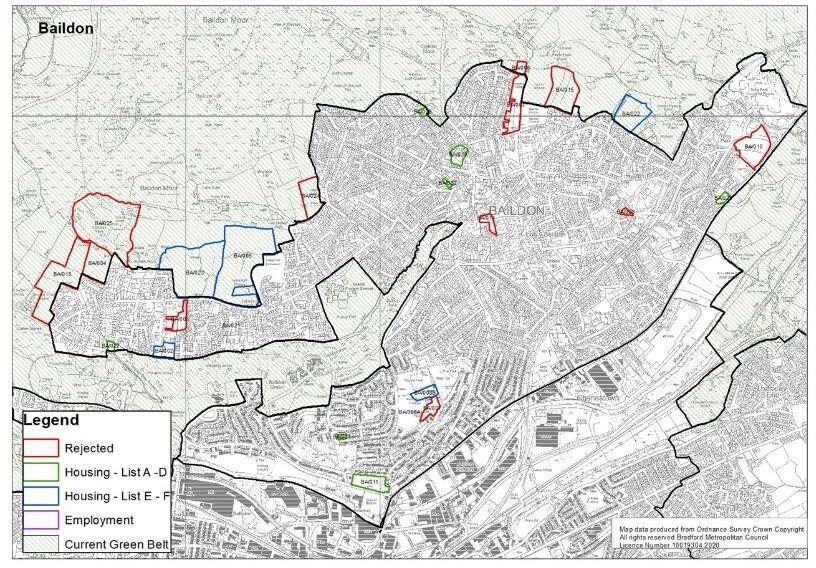
Key Explanation
List A – D. Sites with units remaining under construction, sites with detailed and outline planning permission and sites unconstrained in the urban area.
List E – F. Other sites and Green Belt sites.
